Health Tech Wave Reaches the Hospital Sector, Reflected at KHF 2023
Health Tech Companies and Seminars in the Spotlight at the International Hospital and Health Tech Fair
Smart Hospital Systems, from Hospital Logistics to Data Standardization, Draw Attention
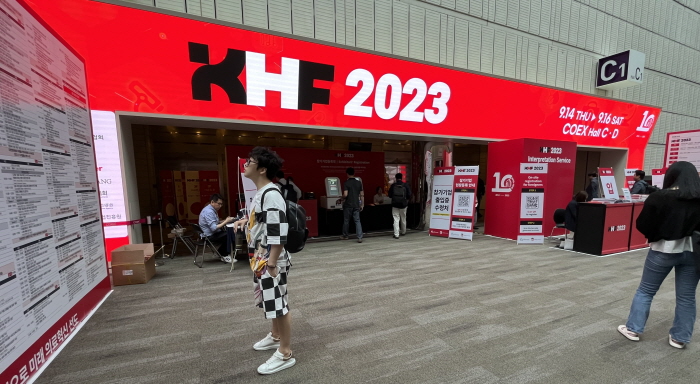
The International Hospital and Health Tech Fair opened on the 14th for a three-day schedule.
[Medical Times = Reporter Lee In-bok]
Amid the broader trend of digital transformation, continuous efforts are being made within the hospital sector—including university hospitals—to integrate health technology into medical services.
Reflecting this trend, the K-HOSPITAL + HEALTH TECH FAIR with HIMSS 2023 (KHF 2023) also featured companies and seminars that highlight the growing role of health tech, drawing significant attention.
According to the medical industry, strong interest has been observed in health tech-related areas at the exhibition held at COEX from September 14 to 16.
This trend was clearly evident in the exhibition booths, where visitors’ attention was heavily drawn to technology companies.
From the opening day, large crowds gathered at booths operated by NAVER Cloud, Oracle, and MegazoneCloud, the Korean partner of Amazon Web Services (AWS).
Visitors showed strong interest in cloud-based hospital information systems, engaging in detailed discussions on implementation cases and potential applications.
Similarly, medical service platforms such as Lemon Healthcare and Pixelro also attracted continuous interest from attendees—marking a notable departure from the traditionally hospital-centered focus of previous KHF events.
In the same vein, the Smart Hospital Pavilion organized by the Korea Health Industry Development Institute (KHIDI) also saw a steady stream of visitors.
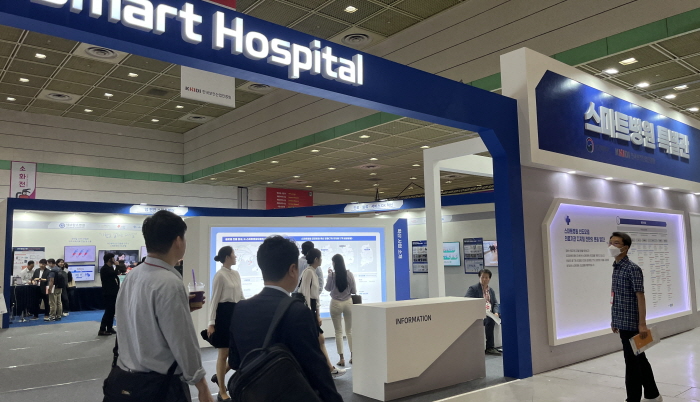
The pavilion showcased smart hospital models developed by Seoul National University Hospital, Severance Hospital, Samsung Medical Center, Keimyung University Dongsan Medical Center, and Kangwon National University Hospital, capturing considerable attention.
Reflecting changes in the hospital sector, smart hospitals emerged as a major topic at KHF 2023.
The Digital Healthcare Special Exhibition was another highly popular section, offering a comprehensive look at next-generation technologies through the participation of numerous digital healthcare companies.
Leading companies in artificial intelligence—including Lunit, VUNO, Deepnoid, and LifeSemantics—as well as Miso Information Technology, Acryl, JLK, Crescom, and Planit Healthcare, focused on introducing their respective solutions.
Events organized by the Inter-Ministerial Medical Device Research and Development Program, which is driving medical device localization with a 4 trillion KRW mother fund, also attracted significant attention.
Companies selected for the program’s Top 10 Flagship Projects, including VATECH, MedInTech, and EOFlow, participated and engaged with visitors.
In addition, the program hosted separate seminars on medical device R&D, inviting experts such as Lee Hak-jong, Director of the Biomedical Research Institute at Seoul National University Bundang Hospital, and Professor Kim Dong-wook of Jeonbuk National University, drawing further interest.
As attention focused on these fields, related forums and seminars likewise highlighted health tech topics.
At the K-Digital Healthcare Summit, major technology companies such as Kakao Brain, NAVER Cloud, and IBM participated to introduce next-generation technologies.
This year also marked the first-ever demonstration event to verify healthcare data interoperability, featuring Hooniverse Global, INFINITT Healthcare, Bit Computer, and SoftNet, which received strong attention.
At the event, Lee Poong-ryul, Head of the Digital Innovation Promotion Group at Samsung Medical Center, presented on digital transformation centered on patient journeys, while Lee Sang-oh, Head of Digital Information Innovation at Asan Medical Center, delivered a lecture on healthcare data standardization and interoperability.
In addition, Kim Il-doo, CEO of Kakao Brain, reviewed AI-based healthcare innovation cases and introduced Kakao Brain’s large-scale model healthcare strategy.
From NAVER Cloud, Yoon Young-jin, Leader, presented on HyperCLOVA X, NAVER’s Korea-specific hyperscale AI, explaining the vision for healthcare applications following its August launch.
Kim Sang-il, Chair of the Future Healthcare Committee at the Korean Hospital Association, stated,
“This summit will serve as a meaningful platform for industry, academia, research institutions, and hospitals to share valuable insights,” adding,
“I hope it will help establish close cooperation between hospitals and companies to foster the digital healthcare industry.”
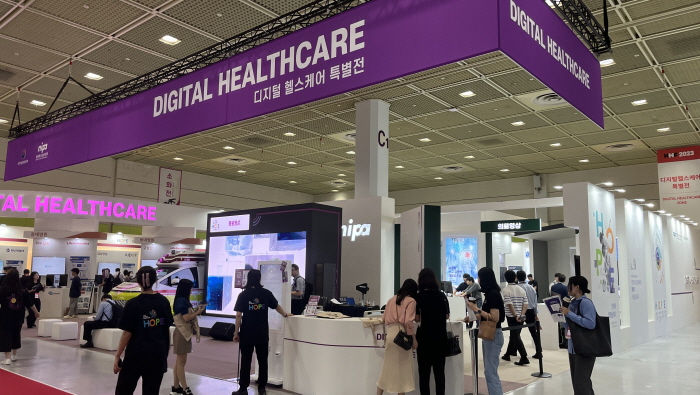
Digital healthcare was once again placed under the spotlight at KHF 2023.
As an exhibition that surveys the hospital industry, events addressing emerging issues—such as AI-based logistics systems—were also organized.
Recently, an increasing number of hospitals have adopted smart logistics automation systems to improve operational efficiency in areas such as inventory and asset management.
Reflecting this trend, the 1st AI Logistics Automation Forum, held for the first time this year, discussed the necessity and direction of hospital system automation using robots and AI.
As a key agenda, Cha Won-cheol, Head of the Digital Innovation Center at Samsung Medical Center, presented on robot-based logistics innovation. Samsung Medical Center is currently leading patient-centered hospital development by utilizing robots for nighttime delivery of medical supplies and minimizing inventory-related tasks.
Presentations were also delivered by Professor Lee Mi-yeon of Hallym University Sacred Heart Hospital and Professor Kim Soo-jung of Yongin Severance Hospital. Both hospitals participated in the AI·5G-based Large-Scale Robot Convergence Model Demonstration Project led by the Korea Institute for Robot Industry Advancement last year, validating the application of robotics in the medical industry.
Notably, the forum also featured presentations on overseas trends, where large hospitals are pursuing cost reduction and efficiency improvements through logistics automation.
A session was held by He Peng Hui, APAC Managing Director of multinational logistics automation leader Swisslog Healthcare APAC, introducing “How Unit Dose and Swisslog Healthcare Solutions Help Hospitals to Reduce Costs.”
Yoon Dong-seop, President of the Korean Hospital Association, stated,
“Hospital systems are currently undergoing numerous changes, particularly in the era of digital transformation,” adding,
“This event was organized to present a vision and highlight paradigm shifts in the healthcare sector.”
- #국제 병원 및 헬스테크 박람회
- #K-HOSPITAL+HEALTH TECH FAIR with HIMSS 2023
- #KHF 2023
View the original article
메디칼타임즈 : https://www.medicaltimes.com/Main/News/NewsView.html?ID=1155426&ref=naverpc


Health Tech Wave Reaches the Hospital Sector, Reflected at KHF 2023
Health Tech Companies and Seminars in the Spotlight at the International Hospital and Health Tech Fair
Smart Hospital Systems, from Hospital Logistics to Data Standardization, Draw Attention
The International Hospital and Health Tech Fair opened on the 14th for a three-day schedule.
[Medical Times = Reporter Lee In-bok]
Amid the broader trend of digital transformation, continuous efforts are being made within the hospital sector—including university hospitals—to integrate health technology into medical services.
Reflecting this trend, the K-HOSPITAL + HEALTH TECH FAIR with HIMSS 2023 (KHF 2023) also featured companies and seminars that highlight the growing role of health tech, drawing significant attention.
According to the medical industry, strong interest has been observed in health tech-related areas at the exhibition held at COEX from September 14 to 16.
This trend was clearly evident in the exhibition booths, where visitors’ attention was heavily drawn to technology companies.
From the opening day, large crowds gathered at booths operated by NAVER Cloud, Oracle, and MegazoneCloud, the Korean partner of Amazon Web Services (AWS).
Visitors showed strong interest in cloud-based hospital information systems, engaging in detailed discussions on implementation cases and potential applications.
Similarly, medical service platforms such as Lemon Healthcare and Pixelro also attracted continuous interest from attendees—marking a notable departure from the traditionally hospital-centered focus of previous KHF events.
In the same vein, the Smart Hospital Pavilion organized by the Korea Health Industry Development Institute (KHIDI) also saw a steady stream of visitors.
The pavilion showcased smart hospital models developed by Seoul National University Hospital, Severance Hospital, Samsung Medical Center, Keimyung University Dongsan Medical Center, and Kangwon National University Hospital, capturing considerable attention.
Reflecting changes in the hospital sector, smart hospitals emerged as a major topic at KHF 2023.
The Digital Healthcare Special Exhibition was another highly popular section, offering a comprehensive look at next-generation technologies through the participation of numerous digital healthcare companies.
Leading companies in artificial intelligence—including Lunit, VUNO, Deepnoid, and LifeSemantics—as well as Miso Information Technology, Acryl, JLK, Crescom, and Planit Healthcare, focused on introducing their respective solutions.
Events organized by the Inter-Ministerial Medical Device Research and Development Program, which is driving medical device localization with a 4 trillion KRW mother fund, also attracted significant attention.
Companies selected for the program’s Top 10 Flagship Projects, including VATECH, MedInTech, and EOFlow, participated and engaged with visitors.
In addition, the program hosted separate seminars on medical device R&D, inviting experts such as Lee Hak-jong, Director of the Biomedical Research Institute at Seoul National University Bundang Hospital, and Professor Kim Dong-wook of Jeonbuk National University, drawing further interest.
As attention focused on these fields, related forums and seminars likewise highlighted health tech topics.
At the K-Digital Healthcare Summit, major technology companies such as Kakao Brain, NAVER Cloud, and IBM participated to introduce next-generation technologies.
This year also marked the first-ever demonstration event to verify healthcare data interoperability, featuring Hooniverse Global, INFINITT Healthcare, Bit Computer, and SoftNet, which received strong attention.
At the event, Lee Poong-ryul, Head of the Digital Innovation Promotion Group at Samsung Medical Center, presented on digital transformation centered on patient journeys, while Lee Sang-oh, Head of Digital Information Innovation at Asan Medical Center, delivered a lecture on healthcare data standardization and interoperability.
In addition, Kim Il-doo, CEO of Kakao Brain, reviewed AI-based healthcare innovation cases and introduced Kakao Brain’s large-scale model healthcare strategy.
From NAVER Cloud, Yoon Young-jin, Leader, presented on HyperCLOVA X, NAVER’s Korea-specific hyperscale AI, explaining the vision for healthcare applications following its August launch.
Kim Sang-il, Chair of the Future Healthcare Committee at the Korean Hospital Association, stated,
“This summit will serve as a meaningful platform for industry, academia, research institutions, and hospitals to share valuable insights,” adding,
“I hope it will help establish close cooperation between hospitals and companies to foster the digital healthcare industry.”
Digital healthcare was once again placed under the spotlight at KHF 2023.
As an exhibition that surveys the hospital industry, events addressing emerging issues—such as AI-based logistics systems—were also organized.
Recently, an increasing number of hospitals have adopted smart logistics automation systems to improve operational efficiency in areas such as inventory and asset management.
Reflecting this trend, the 1st AI Logistics Automation Forum, held for the first time this year, discussed the necessity and direction of hospital system automation using robots and AI.
As a key agenda, Cha Won-cheol, Head of the Digital Innovation Center at Samsung Medical Center, presented on robot-based logistics innovation. Samsung Medical Center is currently leading patient-centered hospital development by utilizing robots for nighttime delivery of medical supplies and minimizing inventory-related tasks.
Presentations were also delivered by Professor Lee Mi-yeon of Hallym University Sacred Heart Hospital and Professor Kim Soo-jung of Yongin Severance Hospital. Both hospitals participated in the AI·5G-based Large-Scale Robot Convergence Model Demonstration Project led by the Korea Institute for Robot Industry Advancement last year, validating the application of robotics in the medical industry.
Notably, the forum also featured presentations on overseas trends, where large hospitals are pursuing cost reduction and efficiency improvements through logistics automation.
A session was held by He Peng Hui, APAC Managing Director of multinational logistics automation leader Swisslog Healthcare APAC, introducing “How Unit Dose and Swisslog Healthcare Solutions Help Hospitals to Reduce Costs.”
Yoon Dong-seop, President of the Korean Hospital Association, stated,
“Hospital systems are currently undergoing numerous changes, particularly in the era of digital transformation,” adding,
“This event was organized to present a vision and highlight paradigm shifts in the healthcare sector.”
View the original article
메디칼타임즈 : https://www.medicaltimes.com/Main/News/NewsView.html?ID=1155426&ref=naverpc