Chi-won Lee, CEO of MedInTech

There is a market in which Japanese companies control 95% of global share—the flexible gastrointestinal endoscope market. Olympus alone accounts for more than 70%, while Fujifilm and Pentax each hold around 10%. These companies are traditional film manufacturers that shifted their core business to the medical field with the advent of the digital camera era.
Such oligopolistic dominance has led to high equipment prices and insufficient after-sales service. Olympus’ latest endoscopy systems are reportedly priced at nearly KRW 200 million per unit.
Against this backdrop, a four-year-old Korean startup has recently begun challenging the long-standing dominance of imported flexible endoscopes. The company is MedInTech, founded by CEO Chi-won Lee, a graduate of Seoul National University’s mechanical engineering and bioengineering programs, in collaboration with researchers from the Korea Electrotechnology Research Institute (KERI).
Earlier this month, MedInTech succeeded in obtaining Korea’s first Class II medical device approval from the Ministry of Food and Drug Safety (MFDS) for its smart motorized endoscope light source and endoscope scope, developed in-house over several years.
In a recent interview with Maeil Business Newspaper, Lee emphasized the significance of the milestone, stating,
“We believe this technology has the potential to fundamentally change the paradigm of diagnostic and therapeutic endoscopy in internal medicine.”
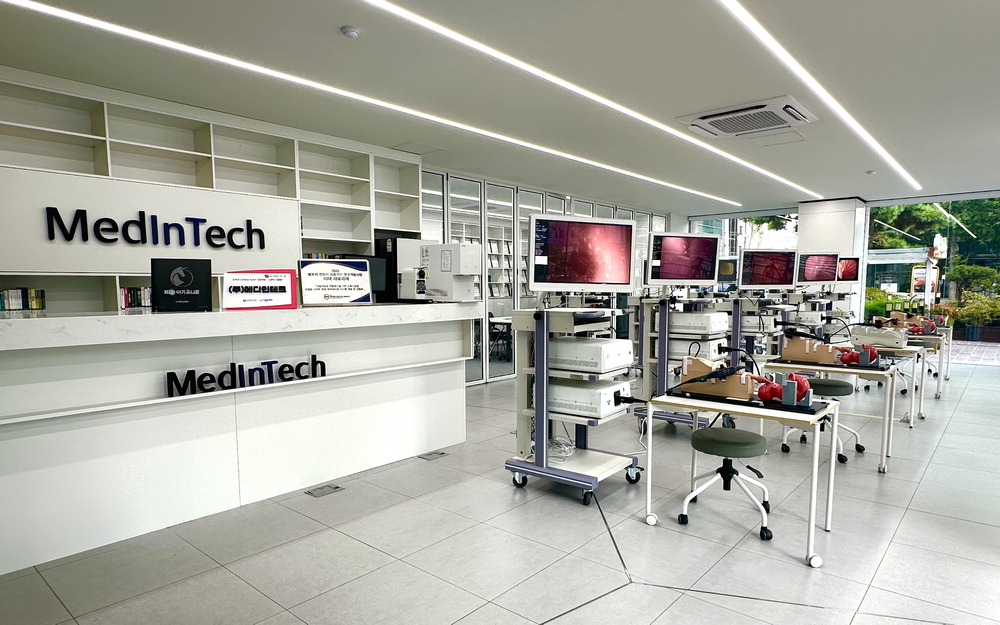
MedInTech Endoscopy Training Center
MedInTech has focused on overcoming the limitations of conventional flexible gastrointestinal endoscopy systems. Existing products rely on mechanical operation, requiring physicians to hold a relatively heavy control body weighing 700–800 grams and manually adjust knobs using only their thumbs. This places a significant physical burden on operators.
By contrast, MedInTech has motorized both the control body and the knobs. This enables the system to track the angle and depth of endoscope bending and to reconstruct the gastrointestinal tract in three dimensions.
CEO Chi-won Lee explained,
“There are medically required anatomical areas that must be examined. If the physician fails to pass through those areas, the system can now issue an alert. This helps prevent blind spots where less-experienced physicians might otherwise miss critical regions.”
The company also applies artificial intelligence (AI) to suppress image instability. Previously, when patients—who are typically sedated rather than fully anesthetized—moved or experienced increased heart rate, visual noise would appear in the video feed. Physicians then had to relocate and re-examine the same area to capture lesion images.
Lee noted,
“The system operates at 30 to 60 frames per second, and when high-quality Full HD images are captured, AI can automatically correct the footage in real time.”
MedInTech plans to obtain medical device approval for this AI software by next year.
In the long term, the company aims to develop a system in which simply inserting the endoscope into the patient’s body will allow the device to automatically detect and navigate target areas, similar to autonomous driving in electric vehicles. MedInTech believes such smart endoscopy will significantly improve convenience for both physicians and patients.
“If autonomous systems are introduced, swallowing will become easier for patients, reducing discomfort,” Lee said. “We also expect physician fatigue and procedure time to decrease substantially.”
Currently, MedInTech is conducting a KRW 9.5 billion (approximately USD 70 million) government-funded, multi-ministerial medical device R&D project in collaboration with Seoul National University Hospital and other institutions. The company plans to begin clinical trials next year to further validate reliability.
MedInTech is also preparing for overseas expansion. Applications for U.S. FDA approval are underway, and the company has initiated the process for European CE certification.
Lee added,
“In Europe, the United States, and Southeast Asia, misdiagnosis rates can reach up to 40%. Unlike mechanical endoscopes, autonomous motorized endoscopes do not require long-term operator training, so we expect their technological impact to be even greater.”
View the original article
-매일경제: https://www.mk.co.kr/news/it/10812052#none


Chi-won Lee, CEO of MedInTech
There is a market in which Japanese companies control 95% of global share—the flexible gastrointestinal endoscope market. Olympus alone accounts for more than 70%, while Fujifilm and Pentax each hold around 10%. These companies are traditional film manufacturers that shifted their core business to the medical field with the advent of the digital camera era.
Such oligopolistic dominance has led to high equipment prices and insufficient after-sales service. Olympus’ latest endoscopy systems are reportedly priced at nearly KRW 200 million per unit.
Against this backdrop, a four-year-old Korean startup has recently begun challenging the long-standing dominance of imported flexible endoscopes. The company is MedInTech, founded by CEO Chi-won Lee, a graduate of Seoul National University’s mechanical engineering and bioengineering programs, in collaboration with researchers from the Korea Electrotechnology Research Institute (KERI).
Earlier this month, MedInTech succeeded in obtaining Korea’s first Class II medical device approval from the Ministry of Food and Drug Safety (MFDS) for its smart motorized endoscope light source and endoscope scope, developed in-house over several years.
In a recent interview with Maeil Business Newspaper, Lee emphasized the significance of the milestone, stating,
“We believe this technology has the potential to fundamentally change the paradigm of diagnostic and therapeutic endoscopy in internal medicine.”
MedInTech Endoscopy Training Center
MedInTech has focused on overcoming the limitations of conventional flexible gastrointestinal endoscopy systems. Existing products rely on mechanical operation, requiring physicians to hold a relatively heavy control body weighing 700–800 grams and manually adjust knobs using only their thumbs. This places a significant physical burden on operators.
By contrast, MedInTech has motorized both the control body and the knobs. This enables the system to track the angle and depth of endoscope bending and to reconstruct the gastrointestinal tract in three dimensions.
CEO Chi-won Lee explained,
“There are medically required anatomical areas that must be examined. If the physician fails to pass through those areas, the system can now issue an alert. This helps prevent blind spots where less-experienced physicians might otherwise miss critical regions.”
The company also applies artificial intelligence (AI) to suppress image instability. Previously, when patients—who are typically sedated rather than fully anesthetized—moved or experienced increased heart rate, visual noise would appear in the video feed. Physicians then had to relocate and re-examine the same area to capture lesion images.
Lee noted,
“The system operates at 30 to 60 frames per second, and when high-quality Full HD images are captured, AI can automatically correct the footage in real time.”
MedInTech plans to obtain medical device approval for this AI software by next year.
In the long term, the company aims to develop a system in which simply inserting the endoscope into the patient’s body will allow the device to automatically detect and navigate target areas, similar to autonomous driving in electric vehicles. MedInTech believes such smart endoscopy will significantly improve convenience for both physicians and patients.
“If autonomous systems are introduced, swallowing will become easier for patients, reducing discomfort,” Lee said. “We also expect physician fatigue and procedure time to decrease substantially.”
Currently, MedInTech is conducting a KRW 9.5 billion (approximately USD 70 million) government-funded, multi-ministerial medical device R&D project in collaboration with Seoul National University Hospital and other institutions. The company plans to begin clinical trials next year to further validate reliability.
MedInTech is also preparing for overseas expansion. Applications for U.S. FDA approval are underway, and the company has initiated the process for European CE certification.
Lee added,
“In Europe, the United States, and Southeast Asia, misdiagnosis rates can reach up to 40%. Unlike mechanical endoscopes, autonomous motorized endoscopes do not require long-term operator training, so we expect their technological impact to be even greater.”
View the original article
-매일경제: https://www.mk.co.kr/news/it/10812052#none